
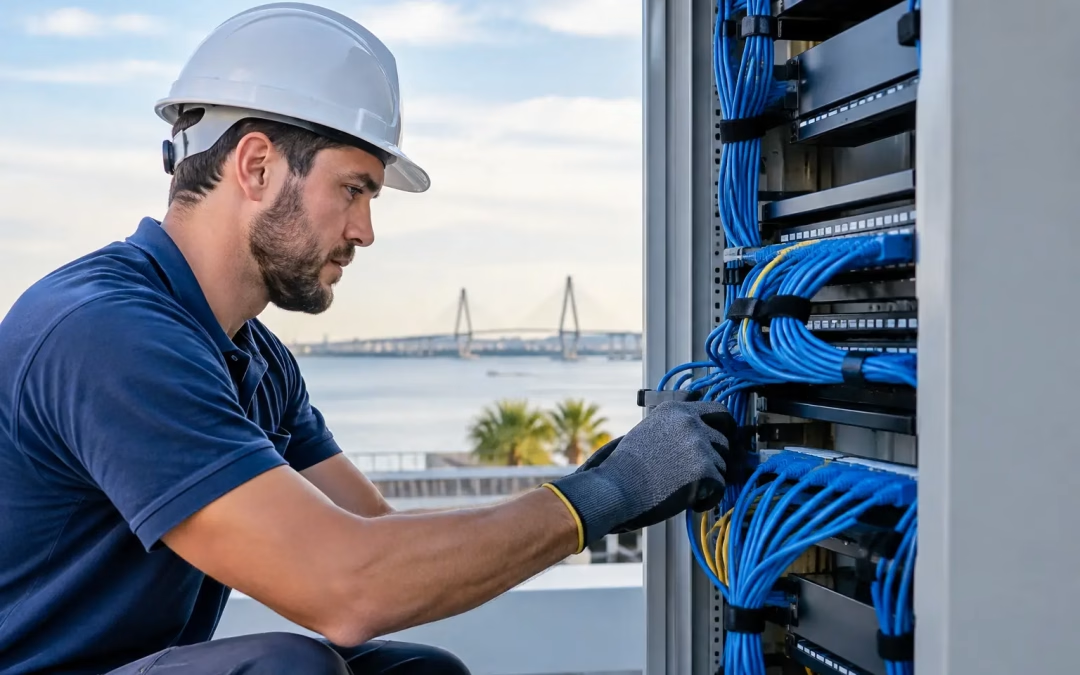
A slow video call in the conference room, dead Wi-Fi in the back office, or a failed connection during a move usually points to more than an internet plan problem. Finding the best network wiring company in Charleston SC means finding a contractor that can identify the physical and operational cause, then build a network that supports how your team actually works.
For a small office, medical practice, warehouse, retail location, or growing home, network wiring is not a background detail. It affects communication, cloud applications, point-of-sale systems, cameras, access control, and the ability to add people or devices without starting over. The right partner plans for current requirements while leaving room for the next lease, expansion, or technology change.
What the Best Network Wiring Company in Charleston SC Should Handle
A quality network wiring provider should do more than pull cable from one room to another. The physical network, Wi-Fi coverage, equipment placement, internet service, and security settings all affect one another. When separate vendors handle each piece without coordination, the client often ends up managing gaps between them.
A capable contractor starts with a site assessment. That includes reviewing the layout, existing pathways, network closet space, device locations, coverage issues, and business-critical systems. An office with ten employees and heavy cloud use needs a different design from a restaurant with guest Wi-Fi, point-of-sale terminals, cameras, and outdoor access points.
From there, the provider should recommend a cabling category that fits the job. Cat5e may be sufficient for limited existing applications, while Cat6 is a common choice for modern office environments. Cat6A can make sense where higher bandwidth, longer runs, or greater future capacity justify the investment. Fiber optic cabling may be the better option between buildings, across larger facilities, or where high-speed backbone connections are needed.
The key is not buying the most expensive material by default. It is choosing an infrastructure plan that matches the site, budget, expected lifespan, and performance requirements.
Look Beyond Cable Installation
Structured cabling matters because it creates the foundation for a dependable network. But the cable itself is only part of the result. A network can be neatly installed and still perform poorly if switches are undersized, access points are placed badly, or the router and firewall are not configured for the business’s needs.
The strongest providers can coordinate the complete environment: cabling, racks and patch panels, switches, wireless access points, routers, firewalls, and VPN access. This does not mean every project requires all new hardware. In some cases, the existing equipment is appropriate and only needs a better layout, cleaner termination, or a targeted upgrade.
For example, weak Wi-Fi is not always solved by adding another access point. Too many access points in the wrong locations can create interference and inconsistent performance. A proper assessment considers wall materials, square footage, user density, conference rooms, outdoor areas, and where people actually use devices. The result should be intentional coverage rather than guesswork.
Ask How the Project Will Be Planned and Tested
A clear process is one of the best indicators of a dependable contractor. Before work begins, you should understand the proposed scope, cable routes, equipment locations, expected schedule, and how the installation will affect normal operations. For an occupied office, timing can be as important as the technical plan.
Ask how the provider minimizes disruption during business hours. Some projects can be completed in phases, after hours, or around a relocation schedule. A contractor should also coordinate with property management, general contractors, IT teams, and internet carriers when the project requires it. That coordination is especially valuable during office moves, where one missed handoff can delay opening day.
Testing should be part of the quoted work, not an afterthought. Each completed cable run should be labeled and verified. Network hardware should be configured and checked for proper connectivity. If Wi-Fi is included, coverage and performance should be validated in the spaces that matter most. Clear documentation gives your internal team or managed service provider a usable record after the installer leaves.
Prioritize Security at the Physical Network Layer
Security discussions often focus on passwords and software, but the network’s physical layout and hardware configuration matter just as much. Open ports in public areas, poorly secured network closets, unmanaged switches, and a flat network where every device can reach every other device all create avoidable risk.
A network wiring company with broader connectivity experience can help segment business systems. Staff devices, guest Wi-Fi, cameras, point-of-sale equipment, and smart building devices often belong on separate network segments. Firewalls and VPNs can be configured to support controlled remote access, while properly installed racks and labeled patching reduce confusion when changes are needed later.
The appropriate level of protection depends on the organization. A professional office, a hospitality property, and a home have different risks and compliance concerns. What matters is that security is considered during the design phase instead of being added only after a problem occurs.
Choose Local Responsiveness, Not Just a Low Bid
The lowest estimate can become costly when it leaves out testing, documentation, cleanup, equipment coordination, or future support. Compare scopes closely. One proposal may cover cable installation only, while another includes planning, labeling, hardware installation, testing, and a clear handoff to your IT provider.
Local responsiveness also has practical value. Businesses in Charleston County, Berkeley County, and Dorchester County often need someone who can visit the site, work through an unexpected building condition, or respond quickly when an expansion changes the original plan. A remote-only vendor may be suitable for certain advisory needs, but it cannot replace hands-on site knowledge when pathways, walls, closets, and equipment locations are involved.
Look for a provider that explains recommendations in plain language. You should know why a cable type, access point location, or firewall configuration is being proposed. Good guidance is specific to your site, not a generic package presented as the answer for every customer.
Questions to Ask Before You Hire
Before choosing a contractor, ask whether they design and install both the cabling and the network hardware, how they test completed work, and what documentation you will receive. Ask who will coordinate with your internet provider if service must be moved or upgraded. If you have an IT company or internal technology lead, confirm how the contractor will work with that team.
It is also useful to discuss growth directly. Will there be spare cable runs for future desks? Is there room in the rack or cabinet for additional equipment? Can the Wi-Fi design support more users during busy periods? These conversations can prevent a small, short-term saving from becoming a major rework later.
For clients who need one accountable partner from assessment through completion, All Wiring Needs combines structured cabling expertise with Wi-Fi optimization, fiber work, hardware installation, network security support, office move coordination, and connectivity sourcing assistance. That broader view helps reduce vendor handoffs and keeps the project focused on business continuity.
The best network installation is rarely the one people notice. It is the one that lets employees work, customers connect, systems communicate, and future changes happen without a scramble. Start with a site-specific conversation, insist on a clear scope and testing plan, and choose a partner prepared to stand behind the infrastructure after the final cable is labeled.
#NetworkWiring #CharlestonSC #StructuredCabling #Cat6 #Cat6A #FiberOptic #WiFiOptimization #NetworkInstallation #OfficeNetwork #BusinessContinuity #NetworkSecurity #CharlestonBusiness #LowCountryBusiness #ReliableConnectivity #OfficeMove #AccessPointPlanning #FirewallSetup #VPNSetup #RackAndStack #CableTesting #ITInfrastructure #CommercialCabling