
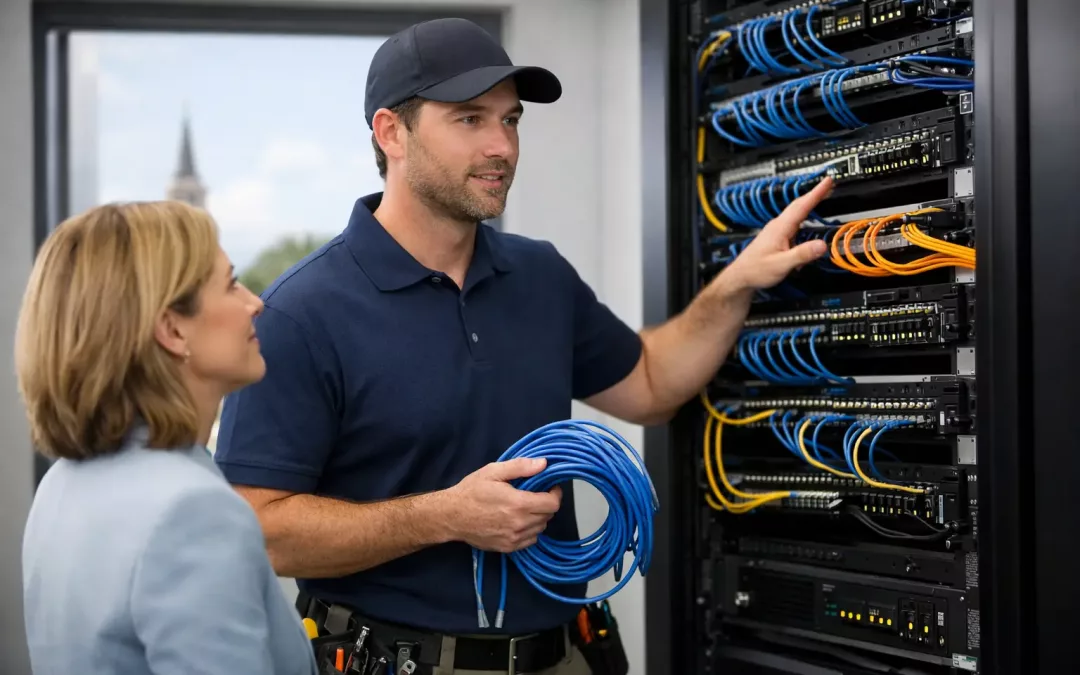
A slow office network rarely starts with the internet plan. More often, the trouble is inside the building – old cabling, poor Wi-Fi placement, messy rack layouts, or hardware added over time without a real plan. If you are looking for a network wiring contractor Charleston businesses can rely on, the real question is not just who can pull cable. It is who can build a network foundation that works well now and still makes sense a few years from now.
That matters whether you are opening a new office, fixing dead zones, expanding your team, or trying to stop recurring network headaches. The right contractor should improve performance, reduce downtime, and make future changes easier instead of leaving you with more patchwork.
What a network wiring contractor in Charleston should actually handle
A good contractor should do more than run lines through walls and terminate cable ends. Structured cabling is the backbone, but the job usually touches several connected pieces at once. That can include network closet layout, rack installation, patch panel organization, switch and access point placement, fiber runs, firewall setup, and testing that confirms the installation performs as expected.
For many businesses, that broader scope is where projects either stay on track or fall apart. One vendor installs cabling, another mounts hardware, another helps with internet service, and nobody owns the full result. When that happens, delays and finger-pointing are common. A contractor with practical experience across cabling, hardware, Wi-Fi, and connectivity planning can save time and reduce handoff problems.
For homeowners, the needs are different but the same principle applies. A home office, media setup, security devices, and wireless coverage all depend on a solid physical network. If the wiring is poorly planned, the whole system feels less reliable than it should.
Why network performance problems often start with physical infrastructure
Businesses often assume every connection problem is an ISP issue or a hardware issue. Sometimes it is. But a surprising number of problems trace back to the physical layer. Old Cat5 cabling, damaged terminations, unlabeled patching, poorly placed access points, or overloaded closets can create instability that looks like random network trouble.
This is why a network wiring contractor Charleston companies hire should be able to assess the full environment, not just quote cable by the foot. If a team member complains about dropped calls, slow file transfers, or weak coverage in one side of the office, the fix may involve cabling upgrades, access point repositioning, switch changes, or a cleaner network design overall.
There is also a cost issue here. Quick fixes can keep a network limping along, but repeated troubleshooting visits and employee downtime get expensive. In many offices, replacing outdated infrastructure is cheaper over time than continuing to patch the same weak spots.
The difference between basic installation and real network planning
Not every project needs a complex design. A small office with a few users may only need clean cabling, proper hardware mounting, and strong Wi-Fi coverage. But even simple jobs benefit from planning.
A contractor should ask how the space is used, where workstations belong, what devices need wired connections, how guests will access the network, and whether growth is likely. They should think about server locations, conference rooms, printers, phones, cameras, and remote access needs before work begins. That planning helps avoid common mistakes like too few drops, bad access point placement, or a network closet that becomes crowded the moment the business adds staff.
This is especially important during office moves and renovations. Relocation projects can be disruptive enough without discovering on move-in day that the internet handoff is in the wrong place, the Wi-Fi does not cover key areas, or the conference room was never wired for the equipment your team actually uses.
What to ask before hiring a network wiring contractor Charleston businesses use
The best conversations happen before the first cable is installed. You want to know how the contractor approaches the project, how they communicate, and whether they understand business operations, not just installation tasks.
Ask how they evaluate a site and whether they test every run. Ask what cable category fits the space and why. Cat5e may still work in some environments, while Cat6 or Cat6A makes more sense for higher bandwidth demands, newer equipment, or longer-term planning. The answer should be tied to your actual use case, not a one-size-fits-all pitch.
You should also ask how they handle Wi-Fi design, network hardware, and security-related setup. A lot of network issues come from weak coordination between those pieces. If a contractor can design the cabling, place access points intelligently, install switches and routers, and support firewall or VPN implementation, the final result is usually more consistent.
It is also fair to ask about project management. Who coordinates the schedule? What happens if the scope changes? How is labeling handled? How will your team know what was installed and where? Clear answers here are a sign that the contractor works in occupied spaces and understands that downtime is costly.
Why local responsiveness matters more than people think
Network projects are not always planned months in advance. A lease gets signed faster than expected. A new suite needs to be occupied quickly. An internet provider changes the install date. A remodel uncovers old cable that needs removal. These situations are common, and they are easier to manage when your contractor knows the local market and can respond quickly.
That is one reason many companies prefer a local provider over a distant firm managing jobs from outside the area. A Charleston-area contractor is more likely to understand local building conditions, coordinate with regional telecom providers, and move faster when last-minute adjustments happen.
Responsiveness also matters after installation. If a business has a question about labeling, a hardware issue, or an expansion in the same space, it helps to work with a company that treats the first project as the start of a relationship, not the end of a ticket.
Security and wiring should not be treated as separate conversations
Some businesses still think of security as software only. In practice, network security starts with infrastructure decisions. Device placement, network segmentation, firewall configuration, VPN access, and the physical layout of your network all affect risk.
That does not mean every office needs an elaborate security buildout. It does mean your contractor should understand how secure connectivity fits into the installation. A cleanly organized rack, correctly installed access points, properly configured hardware, and smart network design all support better control and easier troubleshooting.
The trade-off is that more security planning can add time and cost upfront. For many businesses, that investment is worth it because it reduces exposure and avoids expensive cleanup later. The right level depends on your industry, how your team works, and what data or systems your network supports.
Good wiring work should make future changes easier
The best network installations are not just tidy on day one. They are easier to expand, document, and service later. That means clear labels, tested runs, organized patch panels, room for growth in the rack, and a layout that does not force a full redo every time your business adds devices.
This is one area where experienced contractors stand out. They know a network is not static. A business may add cameras, move teams, open more desks, upgrade internet speeds, or install new access points. A homeowner may add a dedicated office, media room, or better whole-home Wi-Fi. Good infrastructure leaves room for those changes.
At All Wiring Needs, that practical mindset is a big part of the value for clients who want one provider to handle cabling, hardware, Wi-Fi, fiber, and connectivity support without creating unnecessary complexity.
When a full upgrade makes more sense than another patch
There is no rule that every network problem requires a major overhaul. Sometimes a few new cable runs, better access point placement, or a cleaner hardware setup solves the issue. But there are times when repeated small fixes stop being efficient.
If your space has aging cable, years of undocumented additions, unreliable coverage, and hardware that was installed in stages by different vendors, a more complete upgrade may be the better move. It can feel like a bigger step, but it often creates a more predictable network, lowers support friction, and gives your team fewer daily interruptions.
That is usually the deciding factor. A network should support the business, not distract from it. If employees lose time to slow connections, dropped meetings, or workarounds, the infrastructure is already costing more than it appears on paper.
A dependable network starts behind the walls, inside the rack, and in the decisions made before installation begins. If you choose a contractor who understands cabling, hardware, Wi-Fi, security, and the pace of real business operations, you are much more likely to end up with a network that simply does its job and stays out of your way.