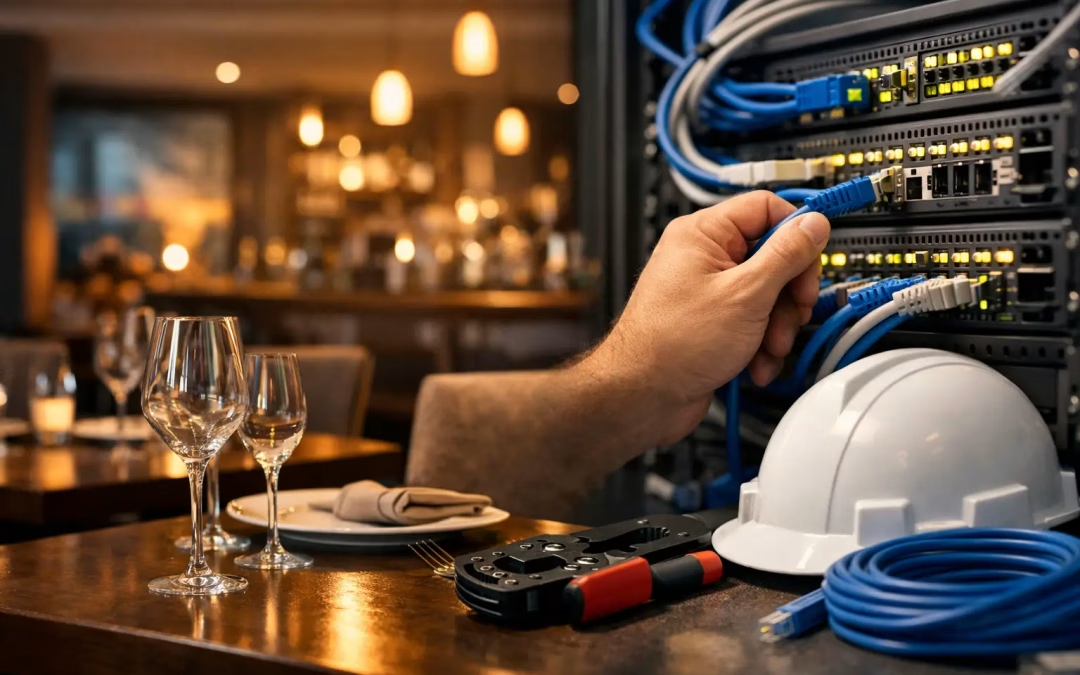
A dinner rush can expose a weak network faster than almost any office environment. Orders stall at terminals, handheld devices drop their connection on the patio, a payment process takes too long, and staff starts working around technology instead of with it. The best network wiring solutions for Charleston restaurants and hospitality begin behind the walls and above the ceiling, with a physical network designed for the pace, layout, and guest expectations of the property.
For restaurants, hotels, cafés, event venues, and other hospitality businesses, internet service alone is not the answer. The connection must be delivered reliably to every point-of-sale station, access point, camera, back-office device, guest area, and management workstation. That requires a plan that accounts for both daily operations and the changes that come with growth.
Start With Structured Cabling That Fits the Floor Plan
Structured cabling is the foundation of a dependable hospitality network. It creates organized, labeled pathways between a central network location and the devices that need a stable connection. Rather than relying on a patchwork of older runs, consumer-grade extensions, and improvised equipment placement, a structured cabling design gives the business a system that can be tested, serviced, and expanded.
Cat6 cabling is often the practical choice for restaurants and smaller hospitality properties. It supports current network demands well and gives room for modern point-of-sale systems, access points, cameras, and office devices. Cat6A may be the better investment where longer cable runs, higher bandwidth requirements, dense device counts, or future expansion are expected. Cat5e can still serve limited needs in existing spaces, but it deserves an honest assessment before a business builds new services around it.
The right choice depends on the property. A fast-casual restaurant with a compact dining room has different needs than a multi-floor hotel, a waterfront venue with outdoor service, or a historic downtown building with difficult pathways. A site walk should identify the network closet location, cable routes, wall and ceiling conditions, kitchen-area constraints, outdoor coverage needs, and the places where future equipment is likely to be added.
Do Not Treat the Network Closet as an Afterthought
The network closet is where organized cabling becomes usable connectivity. A properly planned setup includes a rack or wall-mount enclosure, patch panels, labeled ports, cable management, switches, router or firewall equipment, and appropriate ventilation for the environment. It should be accessible to authorized staff and technicians without being placed where heat, moisture, clutter, or daily traffic can create problems.
Clear labeling is a small detail with a large payoff. When a point-of-sale terminal, camera, or access point needs attention, the team should be able to identify its cable and switch port without tracing mystery wires across the building. That shortens service calls, reduces accidental disconnects, and makes renovations far less disruptive.
Best Network Wiring Solutions for Charleston Restaurants and Hospitality
A hospitality network works best when wired connections and Wi-Fi are planned as one system. Wired infrastructure should handle fixed, business-critical devices wherever possible. Wireless coverage should support mobility without being asked to carry every essential function.
For most operations, the strongest design includes dedicated wired runs for point-of-sale terminals, payment stations, kitchen display systems, printers, office workstations, access points, camera locations, and network hardware. Wired access points are especially important. An access point may provide wireless coverage to dozens of guest and staff devices, but it still needs a dependable wired connection back to the network.
This approach reduces congestion and provides a more predictable experience during busy periods. It also helps isolate problems. If a handheld ordering device loses coverage, the issue can be diagnosed at the Wi-Fi layer rather than questioning whether the entire network backbone is overloaded.
In older Charleston properties, installation planning matters even more. Thick walls, additions built at different times, decorative finishes, and limited access above ceilings can affect both cable routing and wireless signal strength. A local contractor should plan around the building rather than force a generic design that leaves dead zones or exposed cabling in guest-facing areas.
Build Wi-Fi for Guests Without Compromising Operations
Guest Wi-Fi is a hospitality expectation, but it should not share the same unrestricted network as payment devices, management systems, cameras, and staff equipment. Network segmentation separates traffic into controlled groups, commonly using virtual networks and firewall rules. Guests can access the internet while business systems remain isolated.
A typical restaurant or hotel setup may separate guest Wi-Fi, staff devices, point-of-sale equipment, security cameras, and back-office systems. The exact structure depends on the software, hardware, and service providers in use, but the principle is consistent: a guest device should not have a path to systems that process sensitive business or customer information.
Wi-Fi coverage also needs to be measured, not guessed. Access point placement should consider wall materials, kitchen equipment, refrigeration areas, outdoor seating, private event rooms, and the number of simultaneous users. Adding one stronger access point is not always the answer. In many spaces, several properly positioned access points provide better coverage and capacity than one overloaded device.
Protect Payments, Cameras, and Remote Access
Restaurants and hospitality businesses manage more connected equipment than many owners realize. Payment systems, reservations platforms, door access, cameras, music systems, digital menus, inventory tools, and guest devices may all touch the network. Security has to be part of the initial design, not an upgrade considered only after an incident.
A business-grade firewall, secure configuration, controlled remote access, and network segmentation provide a much better starting point than default settings on a basic router. If an owner, manager, IT partner, or vendor needs off-site access, a properly configured VPN is generally safer than leaving management interfaces exposed to the internet.
Camera systems deserve particular attention. They can consume substantial bandwidth and storage resources, especially at larger properties. A dedicated network segment and properly sized switching equipment help keep camera traffic from interfering with point-of-sale and guest connectivity. During design, it is also worth deciding whether cameras need local recording, remote viewing, or both, because that affects cabling and network capacity.
Plan for Peak Service, Not a Quiet Tuesday Afternoon
Network design should be based on the busiest realistic operating conditions. Consider a full dining room, staff handhelds in use, online orders arriving, payment terminals processing transactions, music and digital signage running, cameras recording, and guests connected to Wi-Fi at the same time. If the system only performs well when the building is quiet, it is undersized.
This is also where an internet service review can help. The issue may be internal wiring, insufficient service capacity, poor Wi-Fi design, or a combination of all three. A contractor that can assess the physical network while helping coordinate ISP and telecom options gives owners a clearer path forward. There is little value in paying for faster internet if aging cabling, poorly placed access points, or limited switching hardware remains the bottleneck.
For a new opening, remodel, expansion, or office relocation, install more pathways and cable capacity than the immediate device count requires. Pulling additional cables while walls and ceilings are accessible usually costs far less than reopening finished spaces later. Spare runs create options for another access point, a new register, an extra camera, or technology that has not yet been selected.
Choose a Partner Who Can Execute Without Disrupting Service
Hospitality work requires coordination. Installers must respect operating hours, customer-facing spaces, food-service workflows, construction schedules, and the need to keep critical systems available. The best projects begin with a clear scope, site-specific design, organized installation plan, testing, documentation, and a straightforward handoff to the owner or IT team.
All Wiring Needs helps Charleston-area businesses bring those pieces together, from structured cabling and fiber optic work to network hardware installation, Wi-Fi optimization, security-focused setup, and connectivity planning. The goal is not simply to add cables or devices. It is to create a network that staff can rely on when the pace is highest.
Before the next busy season, renovation, or technology rollout, walk the property with the people who use it every day. Their trouble spots often reveal exactly where the network needs to work harder.
#CharlestonRestaurants #HospitalityTech #StructuredCabling #NetworkWiring #RestaurantWiFi #CommercialNetworking #PointOfSale #NetworkSegmentation #BusinessFirewall #WiFiDesign #Cat6 #Cat6A #HospitalityIndustry #CharlestonSC #ReliableNetwork