
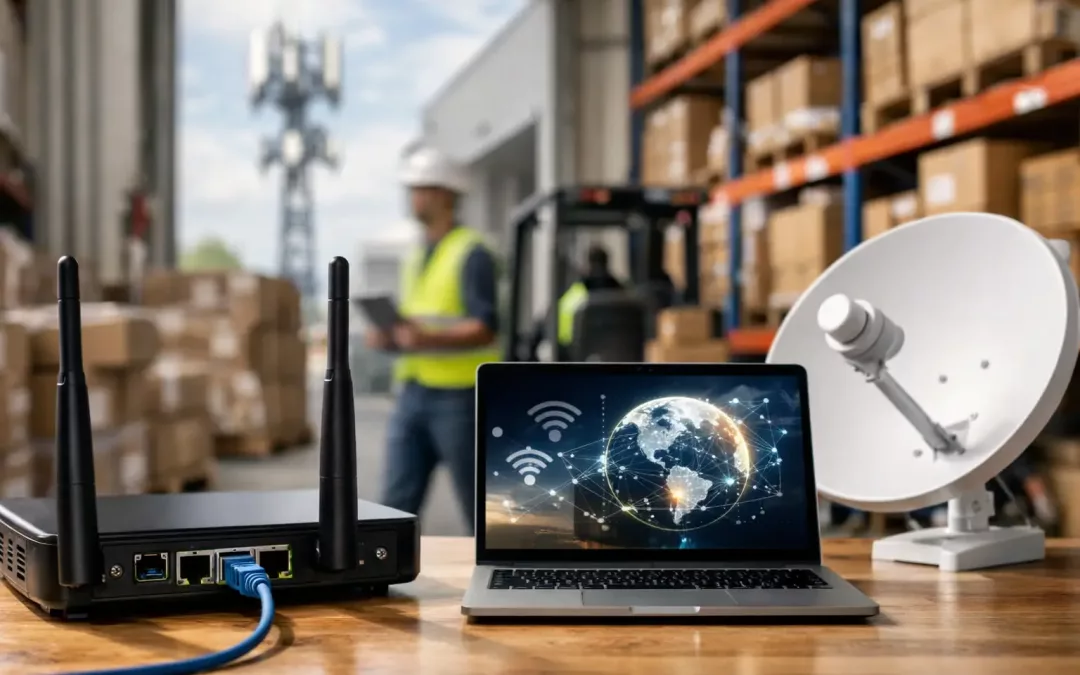
A warehouse can have a fast internet circuit at the front office and still struggle to scan inventory at the far loading dock. Metal racking, concrete walls, outdoor yards, long cable runs, and growing device counts all change the equation. When evaluating business internet options for warehouses and industrial spaces in South Carolina, the carrier connection is only one part of the job. The building’s cabling, Wi-Fi design, network hardware, and backup plan determine whether that connection performs where the work happens.
For operations teams, the goal is not simply a higher speed test result. It is dependable access for scanners, shipping systems, cameras, inventory platforms, guest devices, remote support, and office users without creating bottlenecks or unnecessary downtime.
Start With the Work Your Network Must Support
A small warehouse that only needs email, cloud accounting, and a handful of workstations has very different requirements than a distribution facility using mobile scanners, cloud-based warehouse management software, VoIP phones, video surveillance, and dozens of connected devices.
Before selecting a service, map out what happens on the network during a normal shift and during peak volume. Ask where devices are used, how many can be active at once, and what functions cannot stop if the primary connection goes down. A temporary loss of streaming music may be inconvenient. A loss of shipping labels, dispatch communication, or inventory updates can halt fulfillment.
Upload capacity deserves as much attention as download speed. Security cameras sending footage off-site, cloud backups, video calls, and remote access all rely on upload performance. A low-cost plan with a strong download number but limited upload capacity can become a problem quickly in a busy industrial environment.
Business Internet Options for Warehouses and Industrial Spaces
The best choice depends on what service is available at the property, how critical uptime is, and the layout of the facility. Availability can differ from one industrial park to another, so an address-specific carrier review should come before signing a long contract.
Fiber Internet
Fiber is usually the preferred primary connection when it is available and budget allows. It can provide high bandwidth, low latency, and symmetrical upload and download speeds. That makes it a strong fit for facilities that depend on cloud applications, large file transfers, camera systems, VPN access, and real-time communication between sites.
The trade-off is availability. Fiber may be present on a nearby road but not extended to a specific suite, warehouse, or rear section of a property. Bringing service to the building can involve construction costs, lead times, or contract commitments. For an expanding operation, those costs may still be worthwhile when fiber supports future growth.
Cable Business Internet
Business cable service is widely available and often delivers solid download speeds at a lower monthly cost than dedicated fiber. It can work well for smaller warehouses, contractor yards, and industrial offices with moderate cloud usage.
The main consideration is that performance may be shared within the local service area, and upload speed is often lower than download speed. Cable can be a practical primary connection, especially when paired with a separate backup service. It is less ideal for a site with heavy outbound video traffic, large off-site backups, or strict requirements for consistent performance at all hours.
Dedicated Internet Access
Dedicated Internet Access, often called DIA, is designed for businesses that need a committed connection and service-level expectations around uptime and repair response. It is often a strong option for larger facilities, multi-site operations, companies with hosted systems, or locations where an hour of downtime carries a measurable cost.
DIA generally costs more than standard business broadband. The value comes from predictable capacity, more formal support commitments, and the ability to build a stronger foundation for critical operations. It is not necessary for every warehouse, but it deserves consideration when connectivity supports revenue-producing workflows throughout the day.
Fixed Wireless Internet
Fixed wireless uses a professionally installed antenna to connect a facility to a nearby wireless provider network. In parts of South Carolina where wired options are limited or fiber construction is delayed, it can provide an effective primary service or backup connection.
Results depend on provider coverage, line of sight, weather resilience, site elevation, and the quality of the installed equipment. A site survey matters. Fixed wireless should be evaluated based on real expected performance, latency, data limits, and support terms rather than advertised maximum speeds alone.
Cellular Backup
Cellular service is rarely the best answer for a high-volume warehouse as the only connection, but it is valuable as a failover path. A 4G or 5G backup can keep essential functions running when a cable cut, carrier outage, or equipment problem affects the primary circuit.
The key is to define what should continue during an outage. You may want scanners, shipping stations, phones, payment terminals, and a limited number of office systems to remain online while nonessential traffic is restricted. This prevents a backup connection from being overwhelmed by camera uploads, software updates, or guest Wi-Fi use.
The Building Can Be the Real Bottleneck
A new internet circuit cannot correct poor internal infrastructure. Warehouses create difficult conditions for network coverage: long aisles, tall storage, metal shelving, insulated panels, concrete, dock doors, and changing inventory configurations. An access point placed near the office may offer little usable signal on the floor.
A professional network assessment identifies where structured cabling should run, where access points need to be mounted, and how switches should be sized for current and future devices. Cat6 or Cat6A cabling is often a practical choice for new runs, depending on distance, bandwidth requirements, and anticipated growth. Fiber inside the facility may make sense when connecting distant offices, network closets, detached buildings, or long warehouse spans.
Wi-Fi should be designed around coverage and capacity, not just signal bars. Handheld scanners need stable roaming as employees move between aisles. Cameras, tablets, printers, forklifts, office devices, and visitor access should not all compete on one unmanaged network. Separating business-critical devices from guest traffic and surveillance systems improves control, troubleshooting, and security.
Build for Failure Before It Happens
Even the best carrier can experience an outage. A warehouse that relies on one connection and one piece of network hardware has a single point of failure. The right level of redundancy depends on the cost of downtime, but every operation should have a documented plan.
That plan may include a primary fiber or cable circuit, a cellular or fixed wireless backup, and a router or firewall configured to fail over automatically. It should also include tested battery backup for critical network equipment and clear instructions for employees when service is degraded. A backup that has never been tested is only an assumption.
Security belongs in the same conversation. Industrial networks often connect cameras, access control, employee devices, inventory equipment, and remote users. A properly configured firewall, segmented network, secure VPN access, current firmware, and controlled administrative access reduce exposure without making day-to-day work harder.
Evaluate Providers on More Than Monthly Price
The least expensive quote may be the right choice for a low-risk site, but it should not be the only comparison point. Review installation timelines, construction charges, contract length, upload speed, equipment ownership, data policies, support hours, repair commitments, and whether a static IP address is needed for remote access or security systems.
For facilities in Charleston County, Berkeley County, and Dorchester County, carrier availability and construction requirements can vary sharply between properties. A local infrastructure partner can coordinate provider options while also preparing the cabling, network closet, switches, access points, firewall, and failover equipment the service will depend on. That coordination helps avoid the common problem of an internet circuit being installed before the building is ready to use it.
All Wiring Needs approaches these projects from the inside out: understand the operation, prepare the physical network, and match the connection to the work being done. Whether the answer is fiber with cellular backup, cable with better Wi-Fi coverage, or a dedicated circuit for a growing distribution operation, the right design gives your team a connection they can count on when the docks are busy and the orders need to move.
#WarehouseInternet #IndustrialInternet #WarehouseBusinessInternet #IndustrialBusinessInternet #WarehouseWiFi #IndustrialNetwork #WarehouseConnectivity #SouthCarolinaWarehouse #BusinessInternet #FiberForWarehouse #WarehouseNetwork #IndustrialWiFi #StructuredCabling #NetworkAssessment #CharlestonBusiness