
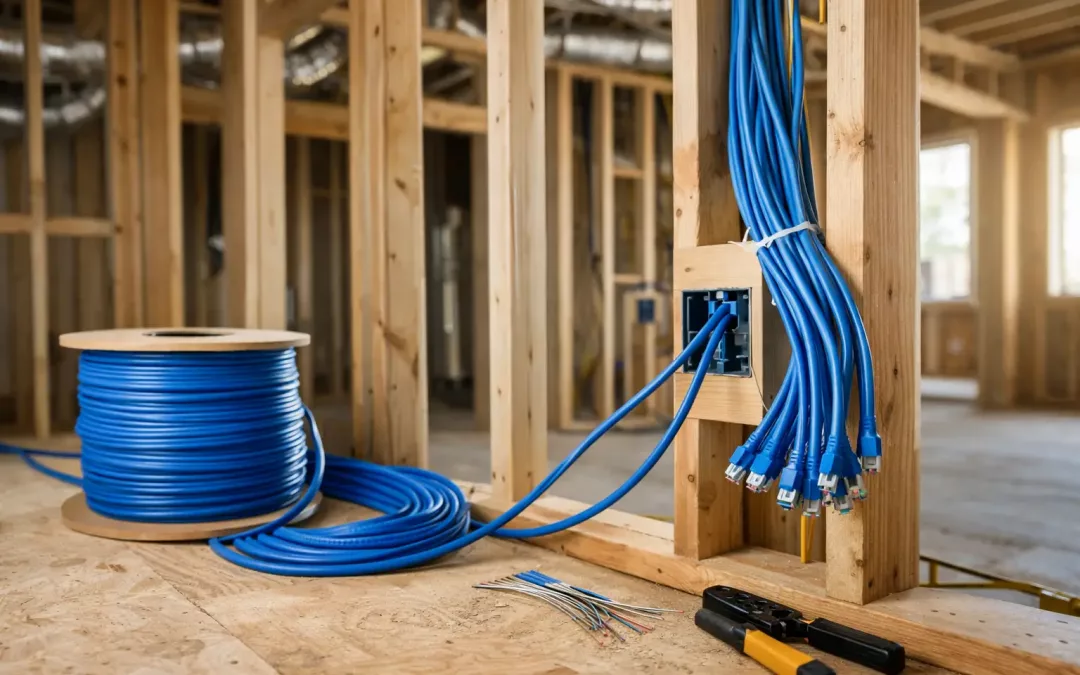
Waiting until the walls are closed is one of the most expensive ways to add network cabling. The best time to install Cat6 data cable is before your insulation and drywall gets installed, when the framing is open and every cable path is visible, accessible, and easier to plan correctly. This is also the best time to consider Cat6Cabling for efficient network setup. Incorporating Cat6Cabling early can lead to significant long-term benefits.
That timing matters for both homes and businesses. If you are building out a new office, renovating a suite, finishing a home, or preparing a retail space, pre-drywall cabling gives you better placement, cleaner routing, and far less disruption. It also gives your installer room to think beyond the immediate need and build for what the space will need next year, not just what it needs on move-in day.
Utilizing Cat6Cabling in your installation can enhance connectivity and future-proof your network.
When planning your network, remember that Cat6Cabling should always be a priority to avoid costly changes later.
Investing in Cat6Cabling allows for reliable connections throughout your property.
With Cat6Cabling, you can ensure that your network infrastructure is capable of supporting high-speed internet demands.
Furthermore, Cat6Cabling allows for easier upgrades in the future as technology evolves.
Integrating Cat6Cabling into your build process is essential for anyone looking to maximize their network capabilities.
Choosing Cat6Cabling can also help reduce interference from other electrical sources.
By planning for Cat6Cabling, you enhance your property’s functionality and increase its value.
Don’t overlook the advantages of Cat6Cabling when preparing your space for installation.
To achieve optimal results, prioritize Cat6Cabling in your network design.
Consider consulting with experts in Cat6Cabling to ensure a successful installation.
Why before insulation and drywall is the best time
Understanding the Importance of Cat6Cabling
Open framing gives you options that disappear once the walls are sealed. Cable runs can be routed directly, neatly supported, and kept away from problem areas that may affect signal quality or future access. It is also much easier to place wall outlets exactly where desks, access points, TVs, cameras, and printers will actually be used.
Once insulation and drywall go in, every change becomes slower and more expensive. A simple cable drop may require cutting, patching, repainting, and working around finished surfaces. In a business setting, that can also mean scheduling after hours, moving furniture, and interrupting staff.
For property owners trying to control project costs, this is one of the clearest wins in the entire build process. Installing Cat6 early reduces labor time, avoids repair work, and makes testing easier before the space is finished.
Best time to install Cat6 data cable before drywall
The sweet spot is after framing is complete and before insulation starts. At that stage, the layout is visible enough to map cable routes, outlet locations, equipment positions, ceiling device placement, and backbone paths without guessing.
This is also the right time to coordinate the network room or structured media location. Too many projects treat cabling as an afterthought, then end up with data lines terminating in a poor location with limited ventilation, no room for growth, or inconvenient access for switches, routers, and ISP handoff equipment.
For offices, that early planning can shape how the business operates. You can place hardwired connections where employees need stable speed, position access points for stronger Wi-Fi coverage, and prepare conference rooms, security devices, printers, and VoIP phones without retrofitting later. For homeowners, it is the easiest moment to wire for home offices, streaming devices, cameras, and wireless access points that actually improve coverage across the house.
What gets easier when Cat6 goes in early
Pre-drywall installation improves more than labor efficiency. It usually leads to a better network.
Ultimately, the choices you make about Cat6Cabling will impact your network’s performance for years to come.
Cable pathways can be designed with fewer bends and cleaner runs. Termination points can be placed with purpose instead of convenience. Device locations can be matched to actual furniture plans and workflow. Testing can happen before finishes cover everything up, which makes corrections faster and cheaper if anything needs to be adjusted.
There is also a long-term advantage. When Cat6 is installed during construction or renovation, it is easier to add extra runs for future devices. That might mean spare lines to offices, additional drops behind displays, or prewiring for access control, cameras, or AV systems. Adding that flexibility now costs much less than opening walls later.
Common mistakes that cause rework
One of the biggest mistakes is waiting until the end of the project to think about connectivity. By then, the furniture plan may be set, but the walls are already closed. Another common issue is underestimating how many drops a space really needs. Businesses often plan for one connection per room, then realize they need separate lines for phones, printers, workstations, access points, and security hardware.
Placement is another problem. A poorly located data outlet can lead to visible patch cables, awkward desk layouts, or weak wireless performance because access points were installed where it was easiest, not where coverage is best.
There is also the issue of future growth. A small office may only need a few data runs today, but expansions, new staff, or upgraded hardware can change that quickly. Good cabling design leaves room to grow without forcing another round of demolition.
When it depends
There are cases where all walls are not open or where parts of a building are already finished. In those situations, Cat6 can still be installed, but the strategy changes. Surface pathways, selective wall access, ceiling routes, or phased installation may be the right approach. The point is not that work becomes impossible after drywall. It is that your options narrow and your costs usually rise.
That is why early coordination matters. A contractor who handles both structured cabling and broader network planning can help you decide what should be hardwired now, what can wait, and where it makes sense to build in extra capacity.
For Charleston-area businesses and homeowners, this is often one of the smartest conversations to have before insulation crews and drywall crews are on the schedule. If the walls are still open, you still have the chance to do it once and do it right.
A fast network starts with the physical layer. If you are building, renovating, or moving into a new commercial or residential space, plan the Cat6 data cabling before the walls appear. Consider the impact of Cat6Cabling for optimal performance.