
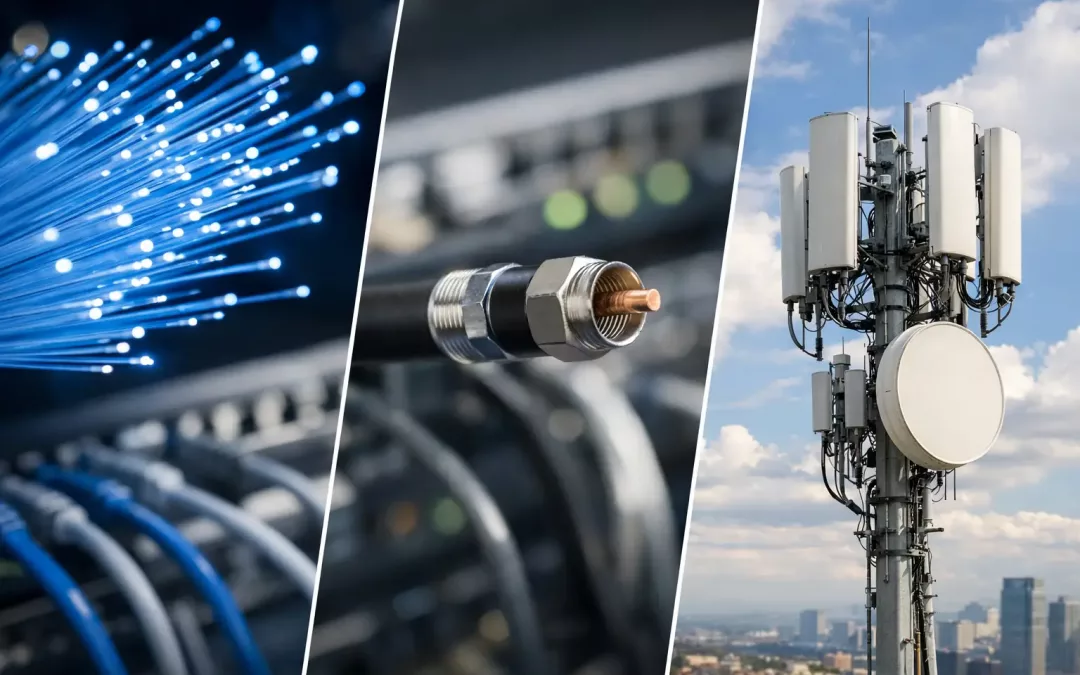
A video meeting freezes just as a client joins. Cloud backups slow down point-of-sale terminals. Staff complain that Wi-Fi is unreliable, but the real issue may be the connection feeding the building. The question, fiber vs. cable vs. 5G business internet: which is right for your business, is not about choosing the newest option. It is about matching the connection to how your business actually operates.
For a small office, retail location, medical practice, warehouse, or growing professional-services team, internet service affects much more than web browsing. It supports phones, payment processing, security cameras, cloud applications, remote access, guest Wi-Fi, and the daily communication your team depends on. The wrong service can create recurring frustration. The right one gives your network a dependable foundation.
Fiber vs. Cable vs. 5G Business Internet
Fiber, cable, and 5G can all be workable business internet options. Their differences show up in speed consistency, upload capacity, availability, cost, installation requirements, and how well they hold up as your team and technology needs grow.
A good decision starts with more than the download speed printed on a provider quote. Ask how many people use the connection at peak hours, whether your operation uploads large files, how critical uptime is, and whether the building has the wiring and equipment needed to distribute service properly.
Fiber internet: best for performance-critical operations
Fiber service sends data over fiber-optic lines and is generally the strongest option for businesses that rely heavily on cloud platforms, video conferencing, hosted phones, large file transfers, or connected security systems. Its most meaningful advantage is often symmetrical service, where upload and download speeds are similar.
That upload capacity matters. A design firm sending project files, a medical office accessing cloud-based records, or a business with multiple cameras uploading footage can quickly feel the limits of a connection designed primarily for downloading. Fiber is also known for low latency, which helps real-time applications respond more quickly.
For offices with 10 or more users, fiber often provides the best long-term value when it is available. It creates room for growth without forcing a near-term service change, especially when paired with Cat6 or Cat6A structured cabling, properly placed wireless access points, and business-grade network hardware.
The trade-off is availability. Fiber may not be serviceable at every address, particularly in older commercial buildings or less-developed areas. Installation can also involve a longer lead time if a provider must extend service to the property. Businesses should verify what is available at the suite level, not just what a carrier claims is available in the neighborhood.
Cable internet: a practical fit for many smaller offices
Cable internet uses the same general infrastructure that supports television service. It is widely available, can be installed relatively quickly, and usually offers strong download speeds at a lower monthly cost than dedicated fiber service.
For a small office that mainly uses email, web-based software, video calls, and standard cloud storage, a business cable plan can be a sensible choice. It may provide plenty of capacity for daily operations, especially when the internal network is designed correctly.
The main consideration is that cable service often provides much lower upload speeds than download speeds. That may not be noticeable when a few employees are browsing online, but it can become a problem when multiple people are on video calls, uploading backups, sending large media files, or accessing hosted applications at once.
Cable performance can also vary more during high-demand periods because local infrastructure may be shared with nearby users. Business-class plans can improve support and service terms, but they do not always eliminate the underlying capacity considerations.
Cable is usually a strong fit when budget matters, fiber is unavailable, and the business has moderate upload and uptime requirements. It can also serve well as a secondary connection for failover, giving a fiber-connected office another path to the internet if its primary service is interrupted.
5G business internet: fast deployment with location-specific limits
5G business internet uses a cellular network and fixed wireless gateway rather than a physical service line brought into the building. Its biggest benefit is speed of deployment. In the right coverage area, a business may be able to get online without waiting for extensive provider construction or a traditional installation appointment.
That makes 5G especially useful for temporary offices, construction trailers, pop-up retail, short-term leases, and locations where conventional services are delayed. It can also be a valuable backup connection for businesses that cannot afford to lose internet access during an outage.
However, 5G performance depends heavily on the site. Signal strength, building materials, gateway placement, nearby network demand, and local carrier coverage can all affect speed and stability. A gateway placed near a window may perform far better than one located in an interior utility room. Thick walls, metal framing, and dense commercial environments can reduce signal quality.
5G may be perfectly adequate for a small team with standard cloud and communication needs. It is less predictable for organizations with high-volume uploading, latency-sensitive systems, extensive camera deployments, or a large number of simultaneous users. Before treating it as a primary service, test performance during the actual hours your business is busiest.
Match the Connection to Your Workload
The best internet choice depends on the work happening behind the walls, not just the number of desks in the office.
A professional office with cloud software, hosted phones, and frequent video meetings may do well with cable if the team is small and usage is moderate. As headcount, cloud dependence, and upload demand increase, fiber becomes the more dependable option.
A retail business may prioritize payment terminals, inventory platforms, guest Wi-Fi, and security cameras. Fiber is ideal if camera traffic and multiple cloud systems are significant. Cable may be sufficient for a single location with limited cameras, while 5G can be useful when a new site needs immediate connectivity before its permanent service is active.
For a business moving into a new space, internet service should be addressed early. Carrier lead times, demarcation point locations, equipment room layout, and cable pathways can influence move-in readiness. Waiting until furniture is in place can turn a straightforward project into a disruptive one.
Internet Service Is Only One Part of Network Performance
A fast service plan cannot fix poor internal distribution. If the router is undersized, wireless access points are poorly located, switches are overloaded, or old cabling cannot support current speeds, users may still experience slow performance and dropped connections.
This is why a site assessment is valuable before committing to a major service upgrade. It should look at where service enters the building, how equipment is protected and organized, how data cabling reaches work areas, where Wi-Fi coverage is needed, and which systems require secure, separated network access.
For example, security cameras, guest Wi-Fi, employee devices, and payment systems should not simply compete on one flat network. Proper network design can separate traffic, improve security, and make troubleshooting much faster when an issue occurs.
Plan for Reliability, Not Just Speed
Internet outages are not always caused by the provider. A damaged patch cable, failing switch, poorly ventilated equipment area, or weak wireless design can interrupt operations just as effectively. Still, the service itself should match the cost of downtime to your business.
If losing connectivity for an hour means missed sales, idle staff, disrupted appointments, or unavailable systems, consider a backup connection. A common approach is fiber or cable as the primary service with 5G as a failover option. When the primary line goes down, the network can switch to the backup path so essential systems remain connected.
Not every business needs this level of redundancy. A small office that can tolerate a brief interruption may be better served by a dependable primary connection and a clear support plan. The point is to make the decision deliberately rather than discovering your tolerance for downtime during an outage.
Choose Based on the Building and the Business
Fiber is usually the first choice for businesses that need high upload speeds, low latency, consistent performance, and room to grow. Cable is often the practical, cost-conscious option for smaller teams with standard usage and good local availability. 5G is compelling for rapid deployment, temporary locations, and backup connectivity, but it should be evaluated carefully as a primary service.
Before signing a contract, verify service availability at the exact address, review upload speeds and service-level terms, and assess the network inside the building. All Wiring Needs helps Charleston-area businesses coordinate connectivity options and build the cabling, Wi-Fi, and network foundation needed to make that service perform where it counts: at every desk, device, and customer touchpoint.
The right connection is the one that supports your current workload without becoming the next bottleneck when your business gets busier.
#BusinessInternet #FiberInternet #CableInternet #5GBusiness #NetworkInfrastructure #StructuredCabling #CloudConnectivity #SmallBusiness #OfficeTech #ITInfrastructure