
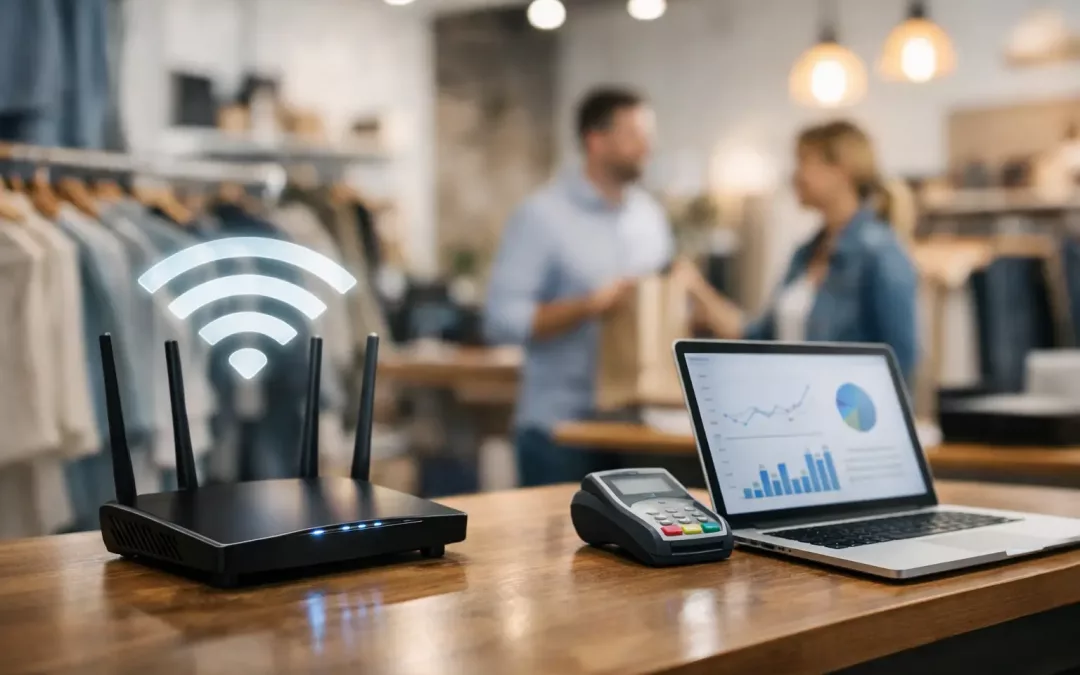
A busy register line at 5:15 p.m. is a bad time to learn your internet is only reliable on paper. When card terminals lag, guest Wi-Fi drags down staff traffic, or one weak access point leaves a dead zone near the fitting rooms, the problem is bigger than speed. Finding reliable business internet for retail stores and shopping centers means looking at the full network path – carrier service, cabling, hardware, Wi-Fi coverage, and how the site actually operates during peak hours.
Retail environments put more strain on internet service than many owners expect. It is not just point-of-sale traffic anymore. Stores now run cloud-based checkout systems, inventory tools, security cameras, digital signage, VoIP phones, vendor tablets, and staff devices, often at the same time. In shopping centers, you may also have multiple tenants, shared utility spaces, outdoor coverage needs, and construction materials that weaken wireless performance. A fast plan by itself does not solve any of that.
What reliable internet really means in retail
Reliable internet is about consistency under pressure. A store may look fine during a quiet mid-morning test, then struggle when checkout traffic, online order pickups, camera uploads, and customer Wi-Fi all hit together. That is why advertised download speeds are only one part of the picture.
For retail stores, the better questions are more practical. How often does service drop? What happens to payment processing during an outage? Is the Wi-Fi designed for your floor plan, or was it pieced together over time? Can the network separate guest traffic from business systems? If a provider promises great speeds but takes days to respond to trouble tickets, that is not a dependable business connection.
Shopping centers add another layer. Landlords, tenants, and property managers may all have different responsibilities, and that can create confusion when service issues appear. The internet may be technically available at the property, but not in a way that supports each tenant well. In those cases, reliability depends as much on planning and infrastructure as it does on the ISP.
Finding reliable business internet for retail stores and shopping centers
The first step is understanding demand at the site, not just buying the biggest package in the provider brochure. A boutique with two registers and light back-office use needs a different setup than a grocery space with self-checkout, security systems, and heavy wireless scanning. In a shopping center, the needs can vary from suite to suite, which is why a one-size-fits-all recommendation usually falls short.
Bandwidth should match real usage, but upload capacity matters too. Many business owners focus on download speed because that is how plans are marketed. In retail, upload performance affects cloud backups, security camera streams, voice quality, and platform sync times. If upload is weak, operations can feel unstable even when download speeds look good in a test.
You also need to account for peak behavior. Stores do not use bandwidth evenly throughout the day. Lunch rushes, after-school traffic, holiday sales, and weekend events create spikes. A connection that barely holds up under normal conditions is more likely to fail when it matters most.
Why the inside network matters as much as the provider
One of the most common mistakes in retail internet planning is blaming the carrier for every performance issue. Sometimes the ISP is the problem. Sometimes the real issue is old cabling, poor equipment placement, overloaded switches, or access points installed with no survey behind them.
That is especially common in stores that have grown over time. A retailer adds another register, installs a few cameras, hangs digital displays, then expands into the suite next door. The network often grows in patches. Eventually, the physical layout and the traffic demands no longer match the original setup.
Structured cabling plays a major role here. Clean, properly tested cabling helps eliminate intermittent issues that are hard to diagnose later. Cat6 or Cat6A may make sense depending on distance, bandwidth goals, and future growth. Fiber can be the right fit for larger properties, longer runs, or high-capacity connections between IDFs and MDFs. The right answer depends on the building and the business plan.
Wi-Fi design is just as important. Retail floor plans are full of obstacles that affect coverage – stockrooms, metal shelving, cooler cases, concrete walls, storefront glass, and neighboring wireless networks. A router on a back counter is not a Wi-Fi strategy. Reliable performance usually requires proper access point placement, signal planning, and separation between staff, guest, and operational devices.
Common retail internet issues that are really design issues
Slow payment processing is often treated like a carrier problem when the issue is local congestion or poor wireless design. Dead zones near checkout lanes or fitting rooms usually point to access point placement. Camera systems that affect office traffic may be sharing bandwidth or switching hardware incorrectly. Guest Wi-Fi can also create headaches when it is left on the same network as business systems.
Security matters here too. Retail locations handle payment data, employee information, and connected devices that should not be exposed. A dependable network should include proper segmentation, firewall protection, secure remote access where needed, and a clear policy for who can access what. Reliable service is not only about uptime. It is also about reducing the chance that one bad configuration or one compromised device affects the whole operation.
Choosing between fiber, cable, and backup options
There is no universal winner among business internet types. Fiber is often the best option for speed, low latency, and scalability, but it is not available everywhere and buildout costs can vary. Cable internet is more widely available and may work well for smaller retail sites, especially if the local provider has strong service quality. Fixed wireless can be useful in some situations, particularly as a backup path, but coverage and consistency depend heavily on the property.
For stores that cannot afford downtime, a secondary connection is worth serious consideration. Failover internet can keep payment systems, phones, and core services online if the primary circuit drops. That does add monthly cost, so it is not necessary for every business. But for higher-volume retail or multi-tenant shopping environments, the cost of one outage during peak hours can easily outweigh the cost of backup connectivity.
Service level expectations matter too. Some providers offer better support, faster restoration windows, or more business-focused account management than others. That is where local guidance can help. A contractor that understands both the physical network and carrier options can often spot problems before you sign the wrong contract.
What to ask before you commit
If you are comparing internet options for a store or shopping center, ask questions that reflect how the site actually runs. You want to know guaranteed versus advertised performance, upload capacity, support responsiveness, installation timelines, contract terms, and what happens during an outage. It also helps to ask whether the building’s current cabling and equipment can support the service being sold.
For shopping centers, ask who controls demarc locations, conduit paths, shared telecom spaces, and any site-specific access requirements. Many delays come from coordination issues, not technical impossibility. If those details are sorted out early, deployments go much more smoothly.
It is also smart to think a year ahead. If you plan to add cameras, digital menu boards, tenant improvements, or more cloud-based systems, buy with growth in mind. Reworking a network twice is usually more expensive than designing it correctly once.
A better approach for store owners and property managers
The strongest results usually come from treating internet as part of the business infrastructure, not as a standalone bill to shop every few years. That means evaluating carrier service, internal cabling, hardware, Wi-Fi, and security together. It also means planning for the customer experience and the staff workflow, not just the ISP handoff.
For many retail businesses, the biggest value comes from having one knowledgeable partner coordinate the moving parts. That may include reviewing provider options, improving structured cabling, installing switches and access points, segmenting networks, and testing the whole environment before problems show up during business hours. For businesses in the Charleston area, All Wiring Needs often helps close that gap between internet service on paper and internet performance in the real store.
If your current setup works only when the store is quiet, it is probably time to reassess the full network, not just the monthly plan. The right internet solution for retail is the one that keeps transactions moving, staff connected, and customers from noticing anything at all.