
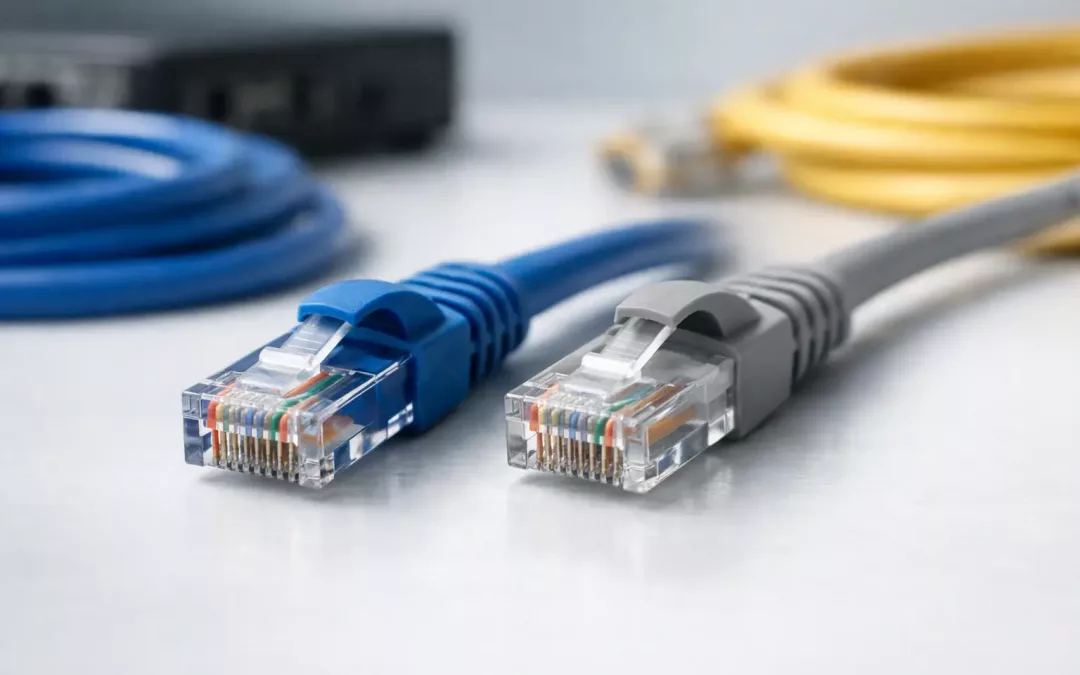
If you’re planning a network upgrade, moving offices, or troubleshooting slow connections, the difference between cat5 and cat6 ethernet cable affects more than just a line item on a quote. It affects speed, interference resistance, future upgrade options, and how long your cabling investment will hold up before you need to revisit it.
For business owners and property managers, that matters because cable is the part you do not want to replace twice. Once walls are open, furniture is moved, and devices are being connected, choosing the right category of cable becomes a practical decision about performance, downtime, and long-term cost.
What is the difference between cat5 and cat6 ethernet cable?
At a basic level, Cat6 is a newer and higher-performing standard than Cat5. It supports more bandwidth, handles higher data rates over shorter distances, and is built to reduce crosstalk and signal interference more effectively.
That said, there is an important real-world detail here: most people comparing these two are actually dealing with Cat5e versus Cat6, not original Cat5. Traditional Cat5 is largely outdated for modern business networks. Cat5e, which stands for Category 5 enhanced, improved on Cat5 and became a common standard for years in offices and homes.
So if someone asks about Cat5 versus Cat6, the practical comparison is usually old-generation cabling versus a more capable modern option.
Speed and bandwidth: where Cat6 pulls ahead
The clearest performance difference is bandwidth. Cat5 is rated up to 100 MHz, while Cat6 is rated up to 250 MHz. More bandwidth means the cable can carry more data more efficiently, which helps when your network is supporting multiple users, cloud apps, VoIP phones, cameras, access points, and large file transfers at the same time.
In terms of speed, Cat5 was originally designed for 10/100 Mbps networks. Cat5e can support 1 Gbps up to 100 meters and is still serviceable in many environments. Cat6 can support 1 Gbps up to 100 meters as well, but it also supports 10 Gbps at shorter distances, typically up to 55 meters under the right conditions.
That difference becomes important in offices where you are connecting servers, uplinks between switches, high-performance workstations, or newer Wi-Fi access points. If your business is adding more bandwidth-hungry devices every year, Cat6 gives you more room before the cable itself becomes the bottleneck.
Why Cat6 usually performs better in busy environments
The difference between cat5 and cat6 ethernet cable is not just raw speed on a spec sheet. Cat6 is also designed with tighter twists in the wire pairs and better insulation characteristics. In many cases, it includes a separator that helps reduce interference between the pairs.
That matters in real installations. Office ceilings, telecom closets, and shared cable pathways can get crowded fast. When cable runs are grouped together near network hardware, security devices, phones, and wireless equipment, crosstalk can become more of a concern. Cat6 is better equipped to maintain signal quality in that kind of environment.
For a small home office, that may not be a deal breaker. For a growing business with multiple drops, patch panels, switches, and access points, cleaner signal performance can mean fewer headaches over time.
Physical differences you may notice during installation
Cat6 cable is often thicker and less flexible than Cat5 or Cat5e. That is not a problem, but it does affect installation planning. It can take up more space in pathways, require more attention to bend radius, and call for proper termination practices to get the performance you are paying for.
This is one reason professional installation matters. A higher-rated cable does not automatically deliver higher performance if it is poorly terminated, kinked, stretched, or bundled incorrectly. The cable, jacks, patch panels, and testing all need to work together as a system.
For customers upgrading an office, this is where experienced structured cabling work pays off. The goal is not just to pull cable. It is to install a network foundation that tests correctly and supports the devices you rely on every day.
Cost: cheaper now versus better value later
Cat5-class cable usually costs less than Cat6, so it can look attractive if you are focused on immediate budget. But cable material cost is only part of the equation. Labor, routing, access, testing, patching, and project coordination often make up a large share of the total job.
That changes the decision. If the labor to install cable is the bigger cost, choosing a better-performing cable often makes sense because the upgrade in material cost may be relatively small compared to the cost of opening things up again later.
For example, if you are wiring a new office buildout, relocating a business, or replacing outdated runs, it often makes more sense to install Cat6 rather than save a little upfront with an older standard. On the other hand, if you are extending a simple existing network for a small number of low-demand devices, the lower-cost option may still be adequate depending on the current infrastructure.
It depends on what the network needs to support over the next five to ten years, not just what is connected today.
Which cable should a business choose?
For most business environments, Cat6 is the better choice. It gives you stronger performance margins, better support for modern network demands, and more flexibility for future upgrades. That is especially true for offices using VoIP, cloud platforms, surveillance systems, multiple access points, or high-speed switching.
Cat5, if it is still present, is usually something to phase out rather than install new. Cat5e can still be usable in many networks, and there are cases where it remains a practical fit. But if you are investing in fresh cabling for a commercial space, Cat6 is typically the more responsible long-term decision.
This is also where site conditions matter. A small administrative office with light traffic has different needs than a medical office, warehouse, retail site, or multi-user professional workspace. The right recommendation should match device count, layout, cable distances, growth plans, and expected bandwidth use.
What homeowners should know
Homeowners are asking this question more often now because home networks do more than stream movies. They support remote work, smart home devices, gaming, security cameras, wireless access points, and video calls happening at the same time.
In a home, Cat5 may still function for basic internet access, but new runs should generally be Cat6 if the walls are being opened or new wiring is being added. It gives better headroom for faster internet tiers and stronger in-home network performance, especially when you want wired backhaul to improve Wi-Fi coverage.
The same logic applies here as it does in a business setting: installed cable is infrastructure. You want to make the choice once and make it count.
When keeping existing Cat5 or Cat5e makes sense
Not every network needs a full rip-and-replace. If an existing cable plant is in good condition, tests properly, and supports the current applications without errors or performance issues, it may be fine to leave some of it in place.
That is why testing matters more than assumptions. We have seen cases where older cabling performed adequately for basic endpoints, while backbone connections or access point drops needed an upgrade. A targeted approach can control costs without limiting performance where it matters most.
This is often the smartest path during office expansions or phased upgrades. Replace the runs that impact speed, reliability, and growth first, then build from there.
The bigger issue is not just cable category
A lot of network frustration gets blamed on the cable type when the real issue is broader. Poor terminations, unmanaged switches, weak Wi-Fi design, outdated hardware, bad patching, and inconsistent testing can all create performance problems.
That is why a cabling decision should be part of a larger network plan. The best results come from looking at the full environment: internet service, switch capacity, wireless coverage, physical layout, security needs, and how the business actually uses the network.
For companies in the Charleston area, All Wiring Needs typically approaches these projects that way – not as isolated cable pulls, but as part of a dependable connectivity system built for daily operations.
So, which one is right for you?
If you are comparing the difference between cat5 and cat6 ethernet cable for a new installation, Cat6 is usually the better investment. It supports higher performance, handles interference better, and gives your network more breathing room as demands increase.
If you already have Cat5 or Cat5e in place, the right move depends on how that cabling is performing, what equipment is connected to it, and whether your space is about to change. A quick answer based on cable labels alone is rarely the best answer.
The better approach is to choose cabling based on the job the network has to do next. That is how you avoid paying twice, reduce downtime, and end up with infrastructure that still makes sense a few years from now.